- Capabilities
- Getting started
- Architecture center
- Platform updates
Navigating VS Code
You can use VS Code workspaces with the Palantir extension for Visual Studio Code to import resources, preview functions, manage branches, commit and publish changes, upgrade your repository, and use local development tools without leaving the editor.
Import resources into a functions repository
Before you use Foundry resources in a function, import them into your repository:
- Select the Resource imports icon, represented by a downward arrow, in the VS Code Activity Bar.
- In the Resources panel, select the Ontology SDK or Platform tab, depending on the resource you want to import.
- Select Add, then choose a resource type, such as an object type, interface, action, query function, or source.
- Find and select the resources you want to use, then confirm your selection.
- Wait for code generation and dependency installation to finish before you reference the resource in your code.
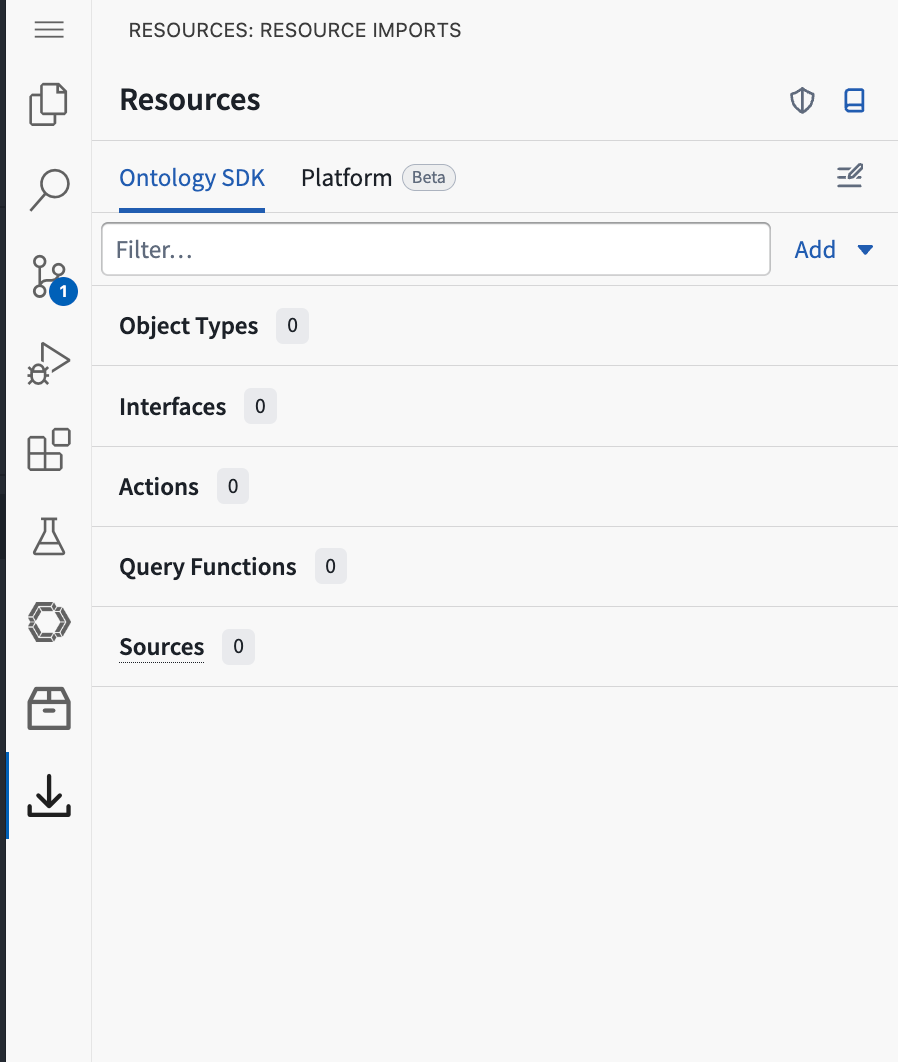
To get the latest available resource types, make sure your repository is up to date via repository upgrades. Learn more about importing Ontology types.
Develop and publish with the Palantir extension
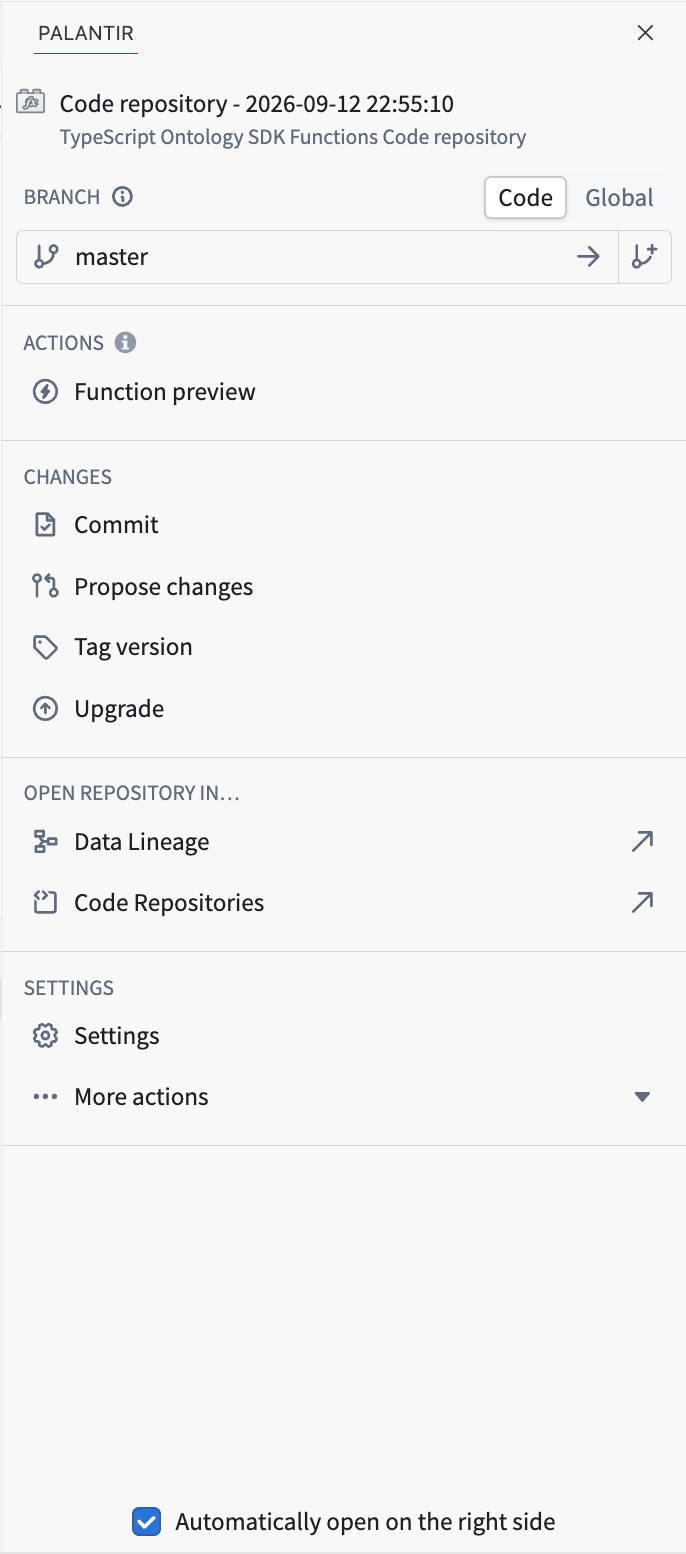
Select the Palantir icon in the Activity Bar to open the Palantir panel - this panel provides branch, preview, commit, publishing, and repository management actions.
Create or switch branches
Use the Branch section to create or switch branches before you begin editing:
- Select the Code or Global tab.
- A Code branch is the underlying Git branch for changes within the code repository.
- A Global branch can contain related changes across multiple supported Foundry applications and resources.
- Select the create branch icon, represented by a branch with a plus sign.
- Enter a name for the new branch, then confirm to create it.
Global branch support depends on the functions language and repository configuration. Learn more about branching in VS Code, branch options in Code Repositories, and developing and publishing functions on a global branch.
Preview a function
- In the Palantir panel, select Function preview.
- Select a function, provide its inputs, and click run to execute your code with the provided input values.
- Review the output, logs, edits, and more, as your code executes. This will help you debug and test your Functions.
If you are developing on a global branch, the preview runs against the branch currently selected in the Palantir panel. Learn more about testing functions in live preview.
Commit, propose, and tag changes
When your preview and tests succeed:
- Select Commit in the Changes section, review the changed files, and enter a descriptive commit message.
- Select Propose changes if your work requires code review before it is merged.
- Select Tag version to choose a version and publish the functions from the selected branch.
Tagging publishes all functions in the repository, not only the function you most recently edited.
Learn more about publishing functions and function versioning.
Upgrade the repository
Select Upgrade in the Changes section to start a repository upgrade. Review the generated changes, run your tests and function previews again, and then commit the upgrade. Learn more about automatic and manual repository upgrades.
Tips and tricks for VS Code
The following sections describe optional VS Code features and shortcuts that can speed up functions development.
Run npm commands from the functions project
Open the integrated terminal and change to the functions-typescript directory, which contains the functions project's package.json file. TypeScript v1 and TypeScript v2 functions repositories use the same path:
Copied!1 2cd functions-typescript npm test
Run npm run to list the scripts available in the current project. For more information about the included test framework, review unit testing functions.
Format when you save
Open Settings, search for format on save, and enable Editor: Format On Save. Press Cmd+S (macOS) or Ctrl+S (Windows/Linux) to save the current file and run the configured formatter. You can also run Format Document from the Command Palette.
Learn more about formatting in VS Code ↗.
Use AI development tools
Palantir MCP is integrated into VS Code workspaces by default and provides context tools for TypeScript function repositories, so the Continue extension can reference your functions code, imported Ontology resources, and Foundry context.
Learn more about AI development tools in VS Code workspaces and Palantir MCP.
Use built-in navigation and editing shortcuts
VS Code includes shortcuts that can reduce context switching:
| Action | macOS | Windows/Linux |
|---|---|---|
| Open the Command Palette | Cmd+Shift+P | Ctrl+Shift+P |
| Quickly open a file | Cmd+P | Ctrl+P |
| Search across the repository | Cmd+Shift+F | Ctrl+Shift+F |
| Go to a symbol in the current file | Cmd+Shift+O | Ctrl+Shift+O |
| Go to a symbol's definition | F12 | F12 |
| Find references to a symbol | Shift+F12 | Shift+F12 |
| Rename a symbol and update its references | F2 | F2 |
| Show available quick fixes | Cmd+. | Ctrl+. |
In Quick Open, add a colon and a line number after a file name, such as myFunction.ts:42, to jump directly to that line. You can also hold Option (macOS) or Alt (Windows/Linux) while selecting locations to add multiple cursors and edit repeated code at the same time. Review the default VS Code keyboard shortcuts ↗ for the complete list.