- Capabilities
- Getting started
- Architecture center
- Platform updates
Derived properties in Workshop
Derived properties are properties whose values are calculated at query time from other properties or from linked objects. Workshop derived properties are runtime-defined. They are declared at the module level, per object type, and exist only within that module rather than being stored in the Ontology.
Runtime-defined derived properties allow builders to perform linked aggregations and calculations across properties directly in Workshop, without modifying the Ontology. Derived properties are compatible with a broader set of widgets than function-backed columns, including pivot tables, where they can be used for aggregation.
Derived properties are supported for a subset of widgets and features. Contact Palantir Support to discuss expanded support.
Configuration
In the Overview tab, select Derived properties from the Capabilities section. You can also select the object type from the Object types section and add a derived property on the next screen.

Derived property types
Linked property/aggregation: Select a linked object property to display from a one-to-one link, or calculate an aggregation across a one-to-many link. Aggregations may only be calculated on the linked object type's native properties, not on other derived properties. You can also optionally apply statically defined object property filters on the linked object type.

For the full catalog of available aggregations and the source property types each accepts, review the derived properties reference.
Column math: Combine values from multiple properties on a single object type. You can reference the object type's native properties and linked property or aggregation derived properties. You cannot reference another column math derived property. For example, if totalCompensation is defined as salary + bonus, a second column math property cannot use totalCompensation; write the full calculation, such as (salary + bonus) * 1.1, in a single column math property instead.

Column math corresponds to the numeric and date expressions available to runtime-defined derived properties across the platform. Review a full list of supported operations.
Performance considerations
Derived properties are computed at query time rather than stored, which may increase module computation times. Consider possible query latency when building performance-critical applications and workflows.
The platform can push many filters down to underlying object indexes, while sorting and some other operations require calculating derived values for the remaining candidate objects. Learn more about the underlying behavior and relative performance of each aggregation.
Limitations
The limitations listed below are specific to Workshop. For platform-wide limitations, review derived properties limitations.
Supported widgets
Derived properties support a subset of Workshop widgets, including the Object Table, Pivot Table, and Waterfall widgets. Hover over the Derived properties information icon for the complete list.
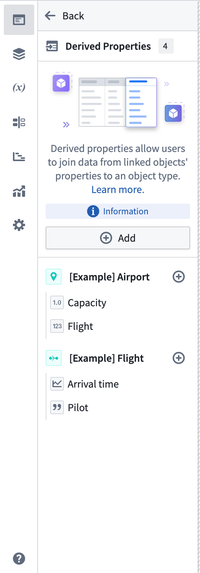
Contact Palantir Support if you need expanded support.
Link traversal
Workshop derived properties support only a single link traversal. If you need a derived property that spans multiple links, consider an ontology-defined derived property, which supports up to three traversals, or a function-backed column with custom traversal logic. You can also restructure your data pipeline to make the required properties available within one traversal.
Sorting
When sorting object sets that use derived properties, the object set size is limited to 200 rows. For larger object sets that require sorting, consider expressing the derived property logic as a function-backed column instead. Function-backed columns support end-user sorting for tables containing up to 10,000 objects. For tables exceeding 10,000 objects, end users cannot sort on the column, and a default sort on the function-backed column will only sort each page of objects as they are loaded.
Saved states
Saved states do not support object sets that reference derived properties.